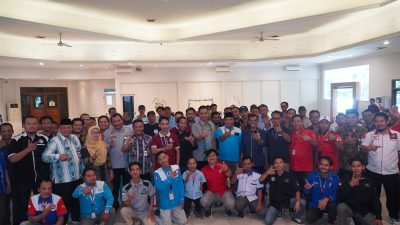
HALO JEPARA- Preventing labor vs community organization conflicts in Jepara, finding a middle way for the interests of workers, entrepreneurs and investments in Bumi Kartini.
The position statement voiced by a number of NGOs in Jepara Regency on Saturday (1/2) “added to the excitement” of the polemic regarding the implementation of the 2025 district sectoral minimum wage (UMSK). Because now, the polemic regarding the ideal amount of sectoral wages is not only among workers, entrepreneurs and the Wage Council Jepara Regency only, but there are also other parties who claim to represent Jepara residents.
A number of mass organizations that also spoke out included MPC Pemuda Pancasila Jepara, DPC GRIB Jaya and others. This mass organization asked the Acting Governor of Central Java to immediately determine the revision of the 2025 UMSK Jepara according to the proposal of the new Acting Regent of Jepara.
The position statement is valid. However, there are concerns that this will trigger conflict between workers and mass organizations. Previously, when workers held a demonstration against the review of UMSK Jepara 2025, there was also a counter demonstration that voiced the opposite aspirations.
It was alleged that the counter demonstration was in line with the position of a number of business associations who expressed objections and threatened to withdraw their investments and not renew workers’ work contracts which expired in 2025. The interests of these entrepreneurs received support from some community organizations (ormas) who were worried about the impact of the loss of investment on Jepara.
Jepara: An Investment Magnet That Remains Strong
However, in the midst of this tension, it is important to understand that the investment climate in Jepara is actually very conducive. This city is known as one of the largest furniture and craft industry centers in Indonesia, with a strong global reputation.
Infrastructure to the port, transportation networks, and the presence of a skilled workforce make Jepara remain attractive to investors.
Therefore, the threat of disinvestment cannot necessarily be used as a reason to suppress policies that have been implemented through social dialogue mechanisms between workers, entrepreneurs and the government.

Jepara’s industrial history proves that the city has continued attraction for investors. Several main factors that support the investment climate in Jepara include the superior workforce.
Jepara has competitive human resources with high skills, especially in the furniture, garment and manufacturing sectors. The availability of experienced labor is an asset for investors who want to maintain production quality.
Jepara products have penetrated the global market, from Europe to the Middle East. The existence of furniture, garment industry clusters and a strong export network are the main reasons why investment remains stable in Jepara.
Regional governments also continue to encourage the development of infrastructure that supports the smooth running of business, such as access to ports and industrial areas. Apart from that, existing regulations provide legal certainty for investors.
The threat of reinvestment made by some entrepreneurs is more of a pressure strategy to review wage policies. However, experience shows that proportional wage increases do not necessarily discourage investment.
On the contrary, with the increasing purchasing power of workers, the regional economy is actually becoming more enthusiastic. For example, in the Special Region of Jakarta, the policy of increasing the minimum wage which increased during the era of governor Anies Baswedan actually contributed to maintaining the stability of the provincial economy.
Don’t clash between workers vs mass organizations
Workers’ actions that will continue to take to the streets must be responded to wisely so as not to lead to wider social clashes. Peacebuilding efforts can be carried out through several strategies. There needs to be ongoing tripartite dialogue facilitated by the government.
The government must continue to facilitate meetings between workers, entrepreneurs and community representatives to formulate solutions that do not harm any party. Transparency in discussing the economic impact of wage decisions can ease tensions.
Community organizations that are worried about the loss of investment need to be provided with a data-based understanding of Jepara’s economic stability. The government and academics can play a role in providing in-depth studies regarding the positive impacts of decent wage policies.
Rather than threatening each other, employers and workers should use mediation mechanisms to resolve differences of opinion regarding wage policy. This step is more productive than mutual pressure actions that lead to prolonged conflict.
Regional governments must be committed to maintaining investment. This requires firmness and confirmation that the increase in the UMK-UMSK is not a threat to investment, but is part of efforts to balance workers’ welfare and economic stability. Incentives for entrepreneurs who continue to invest in Jepara could be a solution to keep the business climate attractive.
Jepara workers have the right to fight for decent wages, while entrepreneurs also have an interest in maintaining the sustainability of their business. However, the threat of disinvestment should not be used as a tool to suppress policies that are in line with workers’ aspirations.
The investment climate in Jepara remains strong, supported by a skilled workforce, global market access and adequate infrastructure. Therefore, a peaceful approach and constructive dialogue are needed so that this dispute does not lead to prolonged conflict.
Workers, entrepreneurs, government and society need to collaborate in maintaining regional economic stability. In this way, Jepara can continue to develop as a fair and highly competitive industrial center, without sacrificing worker welfare or investment sustainability.
Labor welfare is not a threat to investment, but rather the foundation for a stronger economy. When workers’ welfare increases, purchasing power increases, and the wheels of the economy turn faster, that is a true long-term investment to increase productivity.
Read More : Indonesian Vanilla Beans Bulk Supply for Chefs and Bakers
Concern for investment must not sacrifice workers’ rights which have been fought for fairly and democratically. Don’t let momentary interests cloud your view of the common good.
As part of society, mass organizations should be a bridge for dialogue, not fuel to worsen the situation. Let’s together build Jepara as a harmonious, prosperous and competitive city without having to sacrifice any party.
Dr. Muh Khamdan, Trustee of the Paradigm Institute